
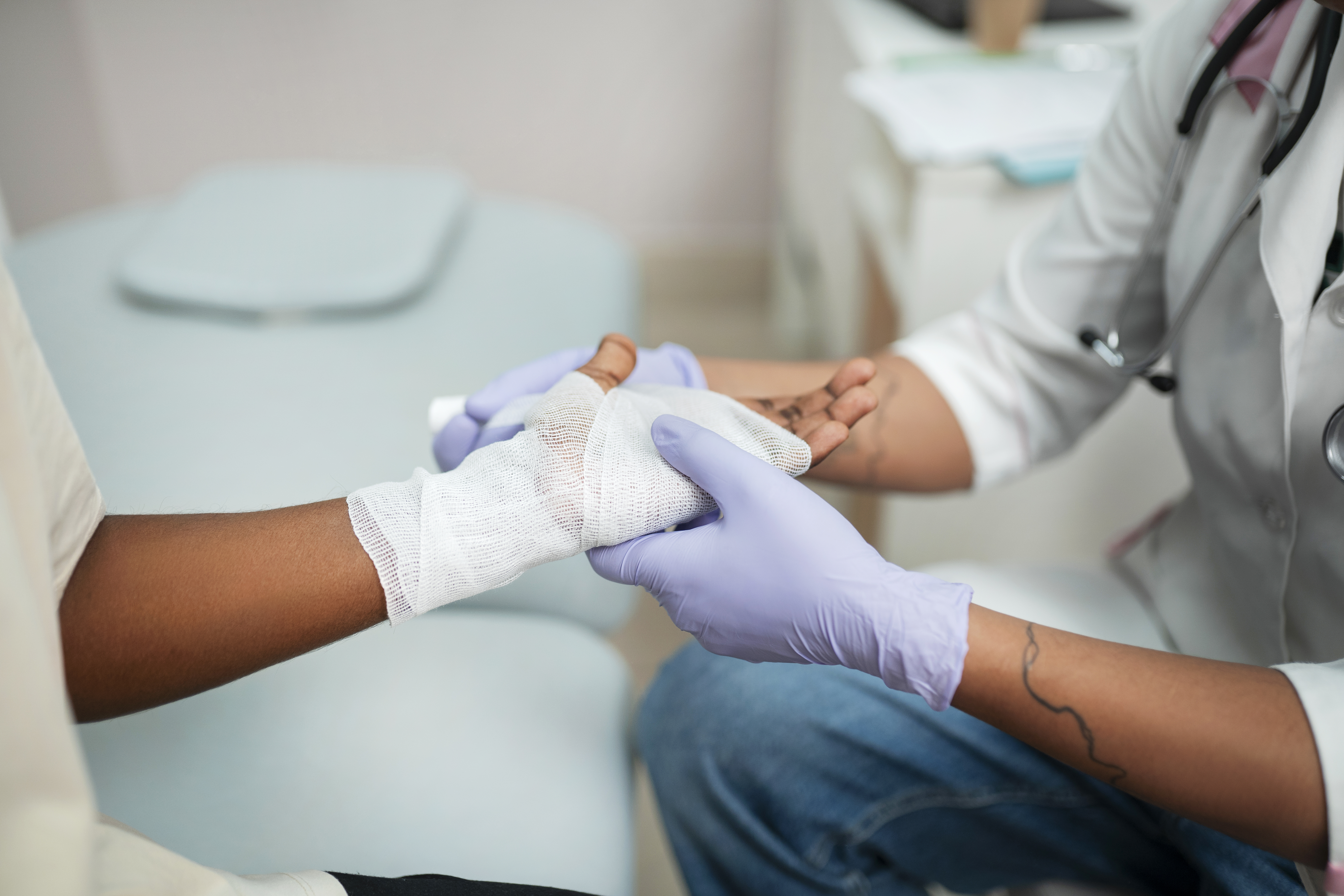
Not every wound heals the same way, and the dressing you put on it makes a bigger difference than most people realize. The right wound dressing keeps the wound moist, absorbs excess fluid, blocks bacteria, and supports your body’s natural healing process. The wrong one can slow healing, cause pain at removal, or create the conditions for infection.
This guide walks you through the most common wound dressing types, when each is used, how often to change them, and the signs that tell you it’s time to stop managing a wound at home and visit a provider. At Concur Urgent Care in Johns Creek and Norcross, GA, our providers assess, clean, and dress wounds using evidence-based protocols — so you leave with the right care plan, not just a bandage.
What Is a Wound Dressing?
A wound dressing is a sterile material applied directly to a wound to protect it, manage drainage, and create the environment the body needs to heal. It is not the same as a bandage. A bandage secures the dressing in place; the dressing itself does the actual therapeutic work.
According to StatPearls (NCBI), effective wound dressings serve six core functions:
- Protect the wound from bacteria, debris, and contamination
- Absorb excess exudate (wound fluid) without drying the wound bed
- Maintain a moist environment that supports tissue regeneration
- Cushion the wound and reduce pain
- Minimize trauma during dressing removal
- Support the four stages of wound healing
The four stages of wound healing — hemostasis, inflammation, proliferation, and remodeling — can span anywhere from a few days for a shallow cut to several months for a complex or chronic wound. Dressing choice actively influences how smoothly each stage progresses, according to wound healing research published on StatPearls.
What Are the Different Types of Wound Dressings?
The type of dressing a provider selects depends on the wound’s depth, location, how much fluid it produces, and whether infection is present. Below are the most commonly used dressing types, based on clinical guidelines from RACGP, WoundSource, and MSF Medical Guidelines.
1. Gauze Dressings
Best for: Clean, lightly draining wounds and surgical incisions.
Gauze is the most widely available and affordable wound dressing. It provides basic physical protection and absorbs a small amount of drainage. The main limitation is that dry gauze can adhere to the wound bed, causing pain and tissue damage when removed. Providers often use non-stick gauze pads or add a thin layer of antibiotic ointment underneath to prevent adhesion.
Change frequency: Every 1 to 2 days, or immediately when soiled or saturated.
2. Transparent Film Dressings
Best for: Superficial wounds, minor abrasions, IV sites, and blisters.
Transparent film dressings (such as Tegaderm or OpSite) are thin, adhesive polyurethane sheets that are waterproof and allow wound inspection without removal. They allow moisture vapor to escape while keeping bacteria out. Because they have no absorbent capacity, they are not appropriate for wounds that produce moderate or heavy drainage.
Change frequency: Every 3 to 7 days if the seal remains intact and the wound stays dry.
3. Foam Dressings
Best for: Moderate-to-heavily draining wounds, pressure ulcers, and skin around IV sites.
Foam dressings are made from soft, highly absorbent polyurethane foam that manages drainage while maintaining a moist healing environment. Silicone-coated foam variants are especially gentle on fragile or sensitive skin and cause minimal trauma on removal. Foam dressings are not appropriate for dry wounds with little to no exudate.
Change frequency: Every 2 to 4 days, depending on drainage volume.
4. Hydrogel Dressings
Best for: Dry or necrotic wounds, partial-thickness burns, and radiation skin damage.
Unlike most dressings that absorb moisture, hydrogel dressings donate moisture to the wound. This makes them the preferred choice for wounds where the tissue is dry, painful, or necrotic, as hydration softens dead tissue and facilitates its removal (a process called autolytic debridement). Hydrogels are soothing and cooling, which also benefits burn patients. They are not appropriate for heavily draining wounds, as excess moisture can cause surrounding skin to break down.
Change frequency: Every 1 to 3 days depending on the wound and formulation.
5. Hydrocolloid Dressings
Best for: Partial-thickness wounds, minor burns, pressure injuries, and post-procedure skin.
Hydrocolloid dressings are self-adhesive, waterproof dressings that form a soft gel over the wound as they absorb exudate, creating an optimal moist healing environment without requiring a secondary dressing. They are a good choice for patients who want to stay active, as many are shower-safe. According to PMFA Journal, hydrocolloids are among the most widely used advanced dressings in outpatient wound management.
Change frequency: Every 3 to 5 days, or when the gel border reaches the wound edge.
6. Alginate Dressings
Best for: Heavily exudating wounds, deep cavity wounds, and post-surgical wounds with significant drainage.
Alginate dressings are derived from seaweed and have a high capacity to absorb exudate, converting to a soft biodegradable gel on contact with wound fluid. They also have mild hemostatic (blood-clotting) properties, making them useful for wounds that bleed lightly. Research published in Science Direct confirms alginate hydrogel dressings are especially effective for advanced wound management in high-drainage scenarios. They should not be used on dry wounds, as they require moisture to function and can damage dry tissue.
Change frequency: Daily to every 2 days depending on drainage level.
7. Collagen Dressings
Best for: Chronic non-healing wounds, diabetic foot ulcers, venous leg ulcers, and complex surgical wounds.
Collagen dressings provide a structural scaffold that stimulates new tissue formation and encourages cell migration into the wound bed. They are used when wounds have stalled in the healing process and are not progressing through normal phases. Collagen dressings are among the more costly options and often require a secondary dressing to hold them in place.
Change frequency: Every 1 to 7 days depending on wound type and exudate level.
A Quick-Reference Guide to Wound Dressing Types
| Dressing Type | Best For | Key Advantage | Not For |
|---|---|---|---|
| Gauze | Clean, lightly draining wounds | Affordable, widely available | Wounds prone to adhesion |
| Transparent Film | Superficial cuts, IV sites | Waterproof, allows visual monitoring | Moderate-to-heavy drainage |
| Foam | Moderate-to-heavy drainage | High absorbency, cushioning | Dry wounds |
| Hydrogel | Dry wounds, burns, necrotic tissue | Donates moisture, soothing | Heavy exudate wounds |
| Hydrocolloid | Partial-thickness wounds, minor burns | Waterproof, shower-safe | Infected or deep wounds |
| Alginate | Heavy drainage, cavity wounds | High absorption, hemostatic | Dry or lightly draining wounds |
| Collagen | Chronic, non-healing wounds | Stimulates tissue regeneration | Acute minor wounds |
Note: Advanced dressing types such as Negative Pressure Wound Therapy (NPWT) and hyperbaric oxygen therapy are hospital-based or specialist interventions. These are not services offered at Concur Urgent Care. If your provider believes you need these treatments, we will refer you to the appropriate specialist.
How Often Should You Change a Wound Dressing?
There is no single answer that applies to every wound. Dressing change frequency depends on the dressing type, the amount of exudate, and whether signs of infection are present. Evidence-based wound care supports a “less is more” approach — disturbing the wound too frequently disrupts granulation tissue and delays healing, according to the Wound Care Education Institute.
General guidelines by dressing type:
- Gauze: Every 1 to 2 days, or when soiled or saturated
- Hydrogel: Every 1 to 3 days
- Foam: Every 2 to 4 days if drainage is controlled
- Transparent Film: Every 5 to 7 days if the seal is intact
- Hydrocolloid: Every 3 to 5 days
- Alginate: Daily to every 2 days based on drainage
Change your dressing immediately if any of the following occur:
- The dressing is soaked through or has leaked
- There is a foul or unusual odor
- The dressing has peeled, shifted, or become contaminated
- You notice increased redness, warmth, swelling, or pus around the wound
- You have new or worsening pain at the wound site
Always follow the specific instructions given by your provider. If you were treated at Concur Urgent Care’s wound care service, your discharge instructions will include your personalized dressing change schedule.
Can You Treat a Wound at Home? Best Practices
Minor wounds — shallow cuts, small abrasions, and superficial scrapes — can often be managed at home if they are clean, not deep, and not showing signs of infection. Proper technique matters. According to MedStar Health, the following steps give a wound the best chance of clean, fast healing.
- Stop the bleeding first. Apply firm, direct pressure with a clean cloth or sterile gauze for at least 10 minutes. Do not lift it to check — add more material on top if needed.
- Rinse thoroughly. Clean running water or a sterile saline solution removes debris and bacteria effectively. Rinse for a minimum of 5 minutes.
- Avoid hydrogen peroxide and iodine on open wounds. Despite being common household products, both damage healthy tissue and slow the healing process.
- Keep it covered and moist. One of the most common misconceptions is that wounds need air to heal. Research consistently shows wounds heal faster in a moist, covered environment.
- Change dressings as directed. Changing too often delays healing; changing too rarely increases infection risk. Follow the schedule your provider gave you.
- Do not pick at scabs. Scabs are part of the healing process. Disrupting them increases scarring and reopens the wound to infection.
- Support healing from the inside. Vitamins A, C, and Zinc, along with adequate protein and hydration, are clinically linked to faster tissue repair.
Keep these basic supplies at home: sterile gauze pads, medical tape, non-stick dressing pads, antiseptic ointment, disposable gloves, and saline wound wash.
What Are the Signs That a Wound Is Infected?
Some degree of redness and swelling in the first 24 to 48 hours after injury is normal — that’s the inflammatory phase of healing. What you’re watching for is redness that spreads, pain that increases instead of decreasing, or new symptoms that appear days after the initial injury. According to OSF HealthCare and the University Hospitals Sussex NHS Trust, these are the signs to watch for.
Early infection signs:
- Redness that spreads beyond the wound edge
- Increased warmth around the wound
- New or worsening swelling
- Pus or cloudy discharge
- Foul odor from the wound
- Pain that gets worse instead of better over time
Signs of serious or systemic infection — seek care immediately:
- Fever above 100.4°F (38°C)
- Chills or shaking
- Red streaks extending from the wound (lymphangitis — a sign infection is spreading)
- Rapid heart rate
- Confusion or extreme fatigue
If you notice red streaks extending from a wound or develop a fever, do not wait. Visit Concur Urgent Care or call 911 if you suspect sepsis.
When Should You Go to Urgent Care for a Wound?
Knowing whether to treat a wound at home, visit urgent care, or go to the emergency room saves time, money, and in some cases, serious complications. The American College of Emergency Physicians provides clear guidelines on this, and TotalCare and Cedars-Sinai reinforce them.
Visit Concur Urgent Care When:
- Bleeding has slowed or stopped, but the cut may need stitches or staples
- The wound is from a clean object (such as a kitchen knife or glass)
- You cannot see bone, muscle, or tendon inside the wound
- The wound shows early signs of infection but you have no fever or red streaks
- You need a tetanus booster — especially if your last shot was more than 5 years ago
- You have a puncture wound that is not bleeding heavily
- You need a professional dressing change for a wound treated elsewhere
- You have a minor burn (first or second degree, smaller than 3 inches) that needs evaluation
Go to the Emergency Room When:
- Bleeding does not stop after 10 to 15 minutes of firm, direct pressure
- Blood is spurting — this indicates a damaged artery
- You can see bone, muscle, tendon, or fat inside the wound
- A foreign object is embedded and cannot be safely removed (do not try to pull it out)
- The wound is a result of an animal or human bite
- The cut is on the face, neck, chest, abdomen, or near a joint
- You have signs of systemic infection — fever, chills, red streaks extending from the wound
- The injury involved a gunshot, major fall, or high-force trauma
Our team at Concur Urgent Care’s walk-in urgent care locations in Johns Creek and Norcross is equipped to handle lacerations, punctures, abrasions, minor burns, and infected wounds without an appointment. For a deeper look at when each option is right for you, read our guide on urgent care vs emergency room visits.
What Wound Care Services Does Concur Urgent Care Provide?
We want to be transparent about what our providers are trained and equipped to handle. At Concur Urgent Care in Johns Creek and Norcross, GA, our wound care services include:
- Wound assessment and triage to determine severity and appropriate care level
- Wound irrigation and cleaning using sterile solutions to remove bacteria and debris
- Debridement (removal of dead or contaminated tissue) when clinically appropriate
- Laceration repair using sutures (stitches), staples, or adhesive strips depending on wound type
- Dressing selection and application using evidence-based dressing types matched to the wound
- Tetanus vaccination when indicated
- Antibiotic prescriptions for confirmed or high-risk wound infections
- Follow-up dressing changes for wounds that require multi-visit management
- Discharge instructions with a personalized at-home wound care plan
What we do not provide: Concur Urgent Care does not offer hospital-level interventions such as Negative Pressure Wound Therapy (NPWT/wound VAC), hyperbaric oxygen therapy, or complex reconstructive surgery. If your wound requires any of these treatments, our providers will evaluate your condition and refer you to the appropriate specialist or hospital setting.
We accept most major insurance plans and offer walk-in availability Monday through Saturday, 9:00 AM to 6:00 PM. Book your appointment online or walk in at either location.
Frequently Asked Questions About Wound Dressings
What is the best wound dressing for a minor cut?
Sterile gauze or a transparent film dressing works well for minor, superficial cuts with minimal drainage. For cuts that need to stay dry and protected over several days, a transparent film dressing (like Tegaderm) is a convenient option since it is waterproof and lets you monitor the wound without removing it.
Are hydrogel dressings good for burns?
Yes. Hydrogel dressings are a recommended first-line option for first- and second-degree burns. They soothe pain by cooling the wound surface and donate moisture to keep the burn bed hydrated, which supports healing. They should not be used on heavily weeping burns where excess moisture could cause surrounding skin to break down.
How do I know if my wound is healing properly?
A healing wound shows progressively less redness, reduced swelling, smaller wound size, decreasing drainage, and eventually a dry scab or closed skin. Pain should decrease over time, not increase. If your wound looks the same or worse after 3 to 5 days of home care, visit a provider for evaluation.
Can I shower with a wound dressing on?
It depends on the dressing. Waterproof dressings like transparent films and most hydrocolloids can be worn in the shower. Non-waterproof dressings like gauze must be kept dry or covered with a waterproof wrap during bathing. Always follow your provider’s specific instructions.
Is it safe to reuse wound dressings at home?
No. Always use a fresh, sterile dressing each time you change a wound covering. Reusing dressings introduces bacteria to the wound bed and significantly increases the risk of infection.
How often should a wound be cleaned and redressed?
For most home wounds, once daily is a reasonable baseline — but the correct frequency depends on the dressing type and wound condition. Advanced dressings like foam or hydrocolloid are designed to stay in place for several days. Always follow the schedule provided by your urgent care or healthcare provider.
Which dressing is used for infected wounds?
Antimicrobial dressings containing silver ions are used for confirmed or high-risk infected wounds. They provide broad-spectrum antibacterial activity directly at the wound site. These are typically combined with oral antibiotics when the infection is spreading. Your provider at Concur Urgent Care will determine whether an antimicrobial dressing is appropriate during your visit.
Does Concur Urgent Care provide Negative Pressure Wound Therapy (NPWT)?
No. Negative Pressure Wound Therapy (NPWT), also called wound VAC therapy, is a hospital-based intervention that requires specialized equipment and ongoing monitoring. Concur Urgent Care does not offer this service. If our providers determine that you need NPWT or another advanced wound care intervention, we will refer you to a wound care specialist or hospital setting.